Tuesday, November 19, 2013

Healing in the Aftermath of Abortion

Her urgent voice traveled over the phone line.
“Where are you, honey?” I sat at my station, scribbling notes on a form provided by the crisis pregnancy center.
“I’m in a phone booth. My mom’s in the grocery store, and she wants me to get an abortion, but I don’t want another one. And if Daddy finds out I’m pregnant, he’ll kick me out of the house.”
I’d received many such intake calls over my two years working at the center. Desperate unwed moms, most of them teenagers, crying out for hope and help. Some of them succumbing to abortions, others, thankfully ending up on our doorstep. My heart hurt for them and also for their unborn babies whose lives hung in the balance. I’d seen the prenatal pictures of a baby’s development, but never did the reality of preborn human life hit me harder than in 1981.
            In November of that year, my husband and I lost our second baby at four months gestation—a perfectly-formed baby boy spanning the length of the obstetrician’s hand. He called it a “spontaneous abortion.” We called him David Nathaniel.
I had no choice in the abortion. My body simply and horribly rejected my child. I not only grieved over my loss, but for all the babies who had been aborted by choice. And for all the mothers who had been duped into thinking that their babies were merely globs of tissue, easily discarded. To my horror, four years later, we lost another baby—Allison Marie.  
Viewing my premature babies, complete with miniature fingernails and tiny toes, gave me a greater appreciation for the sacredness of life at every stage. Sadly, to date, over 50 million babies have died due to abortion on demand. How God’s great heart must grieve over this senseless slaughter of innocent lives. Psalm 139 details how a loving God carefully and meticulously fashions each one of us in the womb, thinks about us day and night, covers us with His hand, and numbers all our days. We are made in His image. So, both preborn babies and their mothers are precious to God. To destroy a life He has created is to tamper with His image. In the case of abortion, a baby’s physical life is destroyed and the mother’s emotional, spiritual, and sometimes even physical well-being is damaged.
Through my latest release, Laughing with Lily, I want women who’ve undergone abortion to know that God loves them, just as deeply and completely as He loves their babies. No matter the guilt or grief they carry, the Lord Jesus Christ, the Wounded Healer, stands ready to cover them with His healing and forgiveness (see Isaiah, chapter 53). And I desire women who haven’t experienced an abortion to understand that the ground is level at the foot of the cross. We all need healing in some form, and when we experience God’s forgiveness through Christ, we can approach others with a balance of truth and grace. 

Visit my Author Page

Tuesday, November 12, 2013

Codependency Workshop

Codependency Workshop
Led by Chuck Rife, LPC, LMFT
Total Life Counseling, Inc.
5401 Fallowater Lane
Roanoke, VA 24016
 Tuesday, November 19, 2013 6:15pm - 8:15 pm $25 per person or $40 per couple (cash or check)
To sign up or for more info call 540-989-1383
Refreshments served
 
Chuck uses God's Word and sound therapeutic resources to help you: See God truthfully See yourself truthfully Treat yourself lovingly Treat others lovingly Work with the body of Christ Use your spiritual gifts with wisdom and balance Speak up Stand up Step back
Bonus feature: Josephine will be there with her coat of many burdens,
plus a FREE copy of Tranquil Moments for each participant!

Tuesday, November 5, 2013

What Mave Does on Thanksgiving Morning . . .

Woman vs. Bird

And I know who wins . . .

Every year, Second Chance protag Mave does the same thing on Thanksgiving morning, but I'll let her tell you about it.

Dancing around the kitchen floor at five in the morning with a naked turkey is not my idea of fun. Nevertheless, Thanksgiving Day wouldn't be complete without my annual battle--woman vs. bird. After inching the stubborn plastic ring off the drumsticks, I plop my captive on the counter, thrust my hand inside the cavity, and retrieve the wrapped giblets to cook up for gravy. Chuckling, I remember asking Jerry this time last year if he wanted the neck.

Gathering the garbage, he'd quipped, "Wanna neck? Sure!"

I rolled my eyes and shot back, "Is that all you ever think about?"

He paused and scratched his head. "Yep, pretty much." Then he slung the bag over his shoulder like Santa Claus and headed for the kitchen door.

Sure, he was joking. Still, what do they always say? There's a bit of truth underneath every joke. Maybe I should have appeased his appetite. Perhaps the growing distance I've felt between us since the kids left wouldn't have occurred if I'd been more attentive to his needs. 

A newbie to the empty nest, Mave misses her kids. She's let her appearance and affection toward her husband slip. Now she wants the fire back in her marriage, but wonders if Jerry's moved on to greener pastures.

But Mave's done some "slipping" out, too, and a couple new people join the Robertson's Thanksgiving table this year as a result. 

And one of them may very well get her in trouble, not only with Jerry, but with the law. 

A signed copy of Second Chance, FREE to one commenter! 

Leave a comment below and automatically enter to win a print copy of Second Chance, in time for Thanksgiving!


Friday, November 1, 2013

Dealing with Holiday Stress

For me, October 31st ushers in the holiday season. While I thoroughly enjoy this time of year, the holidays can also bring added stress . . .

Aunt Edna plunges through the front door loaded down with gifts. On her heels, Uncle Henry grumbles about the cost of fuel. Popping gum with cell phone glued to her ear, niece Marcie stomps in, plops on the couch, and props her snowy feet on your antique coffee table.
Kinda reminds you of National Lampoon’s Christmas Vacation, doesn’t it?
With all our best efforts to prepare for and enjoy the holiday season, we sometimes lament with the Griswold’s wife when she tells her daughter, “Look, it’s Christmas; we’re all miserable!
Take heart. The holiday season doesn’t have to weigh us down with stress if we follow a few helpful guidelines.
Stop. Take a deep breath.
That’s right. In the midst of shopping, food prep, company, programs, and parties, stop and breathe deeply through your nose. Hold it to the count of eight, then let it out slowly to the count of eight. It’s almost impossible to be stressed when you breathe deeply. The exercise slows you down, forces you to regain equilibrium, and sends nourishing oxygen to all of your organs.
Adjust your expectations.  
If your expectations for a happy holiday do not match reality, then your stress level will go up. You may be the type who wants it all—the china, linen, silver polished to a sheen, and the turkey roasted to golden perfection. Gifts wrapped and glittering under a fresh Frazier. Fire lit and house sparkling. Christmas caroling and hot cocoa and cookies waiting at home. You may want to host a neighborhood open house, serve at the Rescue Mission, or take charge of the office party or church drama.
Choose one or two activities that best represent your desire for the holidays. Then let the rest go. You will be doing yourself and everyone around you a big favor. And you’ll likely experience godly contentment, which no amount of gifts or glitter can replace.
Remember, relationships are more important than things.
If you are so frazzled that you can’t sit down and carry on a meaningful conversation with your spouse, family members, or friends, perhaps it’s time to reevaluate. God loves people. That’s His focus. The Babe in the manger came to restore us to the Father. He’s all about relationships. We should be, too. Take time to play games, read the Christmas story, listen to each other, pray together, and laugh around the table. These are the memories you will carry into the future, not how many activities you completed on your list.
Set aside some one-on-one time.
It’s okay to leave Uncle Fred snoozing on the sofa while you slip out with your honey for a well-deserved walk. Work off that heavy meal with a little touch football in the front yard with your teenager. These activities will not only build connection but also provide exercise during a time of year when diets typically fly out the window.
Share the load.
Consider using paper plates instead of china. Delegate various menu items to members of the family. In our household my husband’s motto is Ladies cook, men clean up! I love it!
Take a nap.
With late night parties, church drama practice, or meal and gift prep, it’s likely you’ve been staying up later than usual. Sneak in an afternoon nap to refresh yourself. Even some quiet time alone in your room can help you regroup so that you can jump back into family life and better enjoy those around you.
Count your blessings.
Remember to stop and breathe a prayer of thanksgiving to the One who has richly blessed your life. An attitude of gratitude can go a long way in building strength and fortitude when busyness threatens to swoop in and rob your joy.

For a video clip of Chuck and Eileen discussing holiday stress, log on to the link below.


Sunday, October 13, 2013

Free Kindle Copy of Restored Hearts!


(The following article was first published in 2011 on The Christian Post Bindings blog).


The question, “Who will weep for the homosexual?” has been ruminating in my mind and heart the last day or so.

Is my heart broken for these individuals who through their same-sex thoughts, feelings, and behaviors are longing for a relationship that satisfies?

Those with unwanted same-sex attraction are craving the beauty and pureness of God’s original intent: marriage between one man and one woman for a lifetime (Genesis 2:24-25; Mark 10:6-9; Ephesians 5: 22-33). Moses, Jesus, and Paul tie together the thread of Scripture on marriage, reiterating God’s created design for male and female who are equipped and sanctioned to come together as one flesh. 

The yearning in the heart of one who longs to follow God’s intended model, but feels s/he cannot, creates enormous emotional, psychological, and spiritual conflict.

And rightly so. As with any sinful dysfunction—whether it be greed, alcoholism, compulsive eating, stealing, shopping, or lying—it is conflict that can move the hurting individual to seek help. Pain paves the way for change. In 1 Corinthians 6:9-11, the apostle Paul presents one of the strongest statements concerning the truth that homosexuals can indeed change. In this passage, homosexuality is listed as one among many sins from which the Corinthian believers had been delivered. Paul says, But you were washed, you were sanctified, you were justified in the name of the Lord Jesus Christ and by the Spirit of our God. What great hope this offers those dealing with unwanted same-sex attraction.  

However, restoration is not an easy process. The inner need for acceptance, approval, and love can drive a person to seek satisfaction in any number of forms. An addiction is a person’s way of addressing a love hunger for God, temporarily anesthetizing the emotional pain that usually comes from past hurts. The addiction satisfies for a time—Satan’s way of reeling the person in—but sooner or later the addiction results in a sickening spiral down. The ensuing lack of control creates a greater need, and thus the addiction fuels itself.

For my character, Tim, in the novel RESTORED HEARTS, he seeks the male affirmation he missed from his father in eroticized relationships with other men. The Holy Spirit keeps nudging his heart, causing him to realize the deception of his behavior. He runs from Boston back to his missionary upbringing in India in hopes that he can leave his homosexual lifestyle behind once and for all. But he soon discovers he cannot.

It takes the wise discernment of the mission psychologist to help Tim unearth the roots of his sinful dysfunction and enter into a healing process which incorporates a loving relationship with Jesus Christ at the center. Dr. Hauser weeps for and with this hurting young man over his loss of paternal love and approval. As a godly father figure, he stands with him as he faces his brother’s anger and rejection. When others ignore Tim, Dr. Hauser remains by his side as he struggles, fails, and gets back up again. Like Jesus, he presents a mix of truth and grace. Conviction and compassion. He helps Tim embrace his identity in Christ as a beloved, fully forgiven, and totally accepted son of the heavenly Father (Ephesians, chapter one).  

As I developed my character Tim, I, too, wept alongside of him. His pain became my own. I grieved when his brother rejected him, when the pastor ignored him, and when the Indian girl, Esha, loved him, but was ignored by him because Tim could not respond to her affection. I saw myself in the differing reactions, and I was moved to tears.

My prayer is that I will continue to weep for the homosexual. The struggle is great and not to be minimized in any way. It is a cry for relationship with the Father. Something each of us can prayerfully identify with.

~~
Leave a comment below, along with your email address, and enter to win a Kindle copy of Restored Hearts. Winner announced on October 31!


Tuesday, October 8, 2013

How to Read the Bible as Literature


     Great literature is all about human experience. That’s precisely what makes the Bible so compelling. It is first of all a literature book full of stories, poetry, proverbs, and parables that offers the reader a glimpse into both God’s heart and the human heart. The tension between good and evil runs as a consistent theme throughout with God’s redemption ever the central story line.
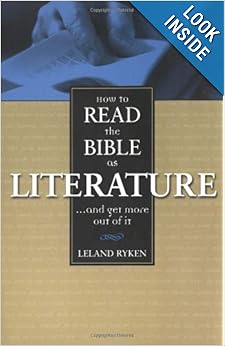
    With this understanding, I’ve longed to introduce my creative writing students to a deeper understanding of the Bible as literature. What literary tools did the writers use to convey their thoughts and feelings? My search led me to my son-in-law, a seminary professor and serious student of God’s Word. He referred me to a gem of a book titled How to Read the Bible as Literature . . . and get more out of it by Leland Ryken.      
In his helpful book, Ryken opens the door to a greater appreciation of the artistic beauty of Scripture. Employing an array of literary devices, the biblical writers take the reader on a journey of discovery. From the epic accounts of the Exodus to the visionary literature of Revelation, the reader experiences unity and coherence through the masterful use of metaphor, simile, symbol, foil, hyperbole, allusion, personification, dramatic irony, and satire, to name a few. It is precisely this dissection of the biblical writers’ use of literary tools that Ryken contends will bring more understanding to a passage.
For example, when the psalmist says “All night long I flood my bed with weeping” (Psalm 6:6), he is using hyperbole, an exaggeration, not literal fact. The writer draws upon hyperbole to express how strongly he feels about the situation. Obviously, it is impossible to literally flood one’s bed with tears. To imagine such a scenario is quite comical, yet the structure is effective in communicating the writer’s emotion.
In another instance, the psalmist uses an allusion or historical reference. In Psalm 33:6, he says, “By the word of the Lord were the heavens made.” The Psalmist refers to a point in history when God spoke the world into existence.
In the New Testament, the power of parable is prevalent. The gospel writers provide numerous accounts of Jesus’ masterful storytelling skills. According to Ryken, Jesus often “used obvious and heightened foils (contrasts) . . .The rich man and Lazarus, the Pharisee and publican, the generous employer and the selfish workers, the wise and foolish virgins”(141). The parables draw a line in the sand, if you will, forcing the reader or listener “to take sides for or against the characters,” Ryken contends (142).
Even the New Testament epistles (letters) make use of literary devices. Consider the aphoristic sayings of 1 Corinthians 15:33: “Bad company corrupts good character” and Galatians 5:9: “A little yeast works through the whole batch of dough.” Notice the paradox in 2 Corinthians 12:10b: “when I am weak, then I am strong.”
Consider the visionary literature of Revelation which transcends the ordinary. Revelation is an epic work which takes place on a cosmic stage with scenes shifting between heaven and earth. Such a technique calls for the reader to step out of the familiar and use his imagination. The use of symbols such as thunder, lion, earthquake, dragon, or harvest is prevalent and can be readily understood with the knowledge that “literary symbolism tends to be a universal language that recurs throughout literature” according to Ryken (173).
How to Read the Bible as Literature (203 pages) is divided into twelve chapters and includes an appendix of the allegorical nature of the parables, an index of persons, and an index of subjects. Each chapter provides helpful sidebars that highlight the most significant points of the chapter. Plentiful scriptural examples are included to illustrate each literary tool discussed. Wide margins are designed for note taking. Further resources at the end of each chapter are listed to enhance the reader’s understanding of specific literary devices. 
How to Read the Bible as Literature by Leland Ryken unpacks a gold mine of literary tools and how those devices, rightly examined, can lead to a richer understanding of God’s Word. A great resource for laymen and clergy alike.
~~

SPECIAL NOTE: Sorry I'm not able to post a picture at this time. Blogger is acting up. 


Monday, September 30, 2013

For Writers: The Power of a Book Cover

A few months before RESTORED HEARTS was released, a woman approached me anxious to know when the book would be ready. I told her the manuscript was in the hands of my editor and would prayerfully be available soon.
The woman's son was grief-stricken and angry over his father's homosexual lifestyle. This mom was concerned that her ex-husband's behavior would destroy any hopes for a relationship between her son and his dad.
When RESTORED HEARTS came out, she bought a copy, read it, then passed it along to her son. I told her I would pray for healing and restoration in her family. The son made it to chapter three but could go no further. He closed the book and laid it aside. The reality of what many homosexuals encounter was too difficult for him to swallow.
That was two years ago. Even though I had not received any updates on this particular situation, I continued to pray as the Lord brought this family to mind.
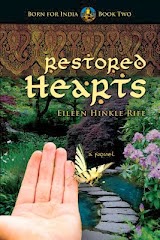
A few months ago, the woman approached me again, this time with a spark of hope in her eyes. She told me that her son was sitting on a park bench when a butterfly landed on his backpack. He did a double-take when he realized the insect was the exact same species as the one on the RESTORED HEARTS book cover. Perhaps I need to go back and finish reading that book, he thought.
His mother reported that he did finish the book and told her he had changed his attitude toward his dad. He now wanted to seek healing and restoration for their relationship.
Sometimes, it's the small things—like a butterfly on a book cover revisited at a park bench—that God can use to make all the difference in the world.
 ~~
Eileen Rife is the author of the Born for India trilogy, inspired by her single missionary daughter’s call to India. She and her husband, Chuck, conduct marriage seminars in the states and overseas. www.eileenrife.com, www.guardyourmarriage.com

Everything is Never Enough by Bobby Jamieson, A Book Review

  What does it take to make you happy? My chronological Bible reading of late brought me to Ecclesiastes where I discovered an irresistible ...